Forum
Important Notice for New User Registrations
To combat an increasing number of spam and bot registrations, we now manually approve all new user registrations. While this may cause a delay until your account is approved, this step is essential to ensure the quality and security of this forum.
To help us verify your registration as legitimate, please use a clear name as user name or an official email address (such as a work, university, or similar address). If you’re concerned that we may not recognize your registration as non-spam, feel free to email us at with a request to approve your username.
Upwind vs Downwind Turbine

Quote from Andhi.Kusnadi on 31. October 2025, 06:50Hi,
I would like to clarify if a downwind turbine subjected to wind in 0° direction would exhibit the same thrust load as an upwind turbine subjected to wind in 180° direction (with the appropriate reversal of rotor rotation and blade twist angles).
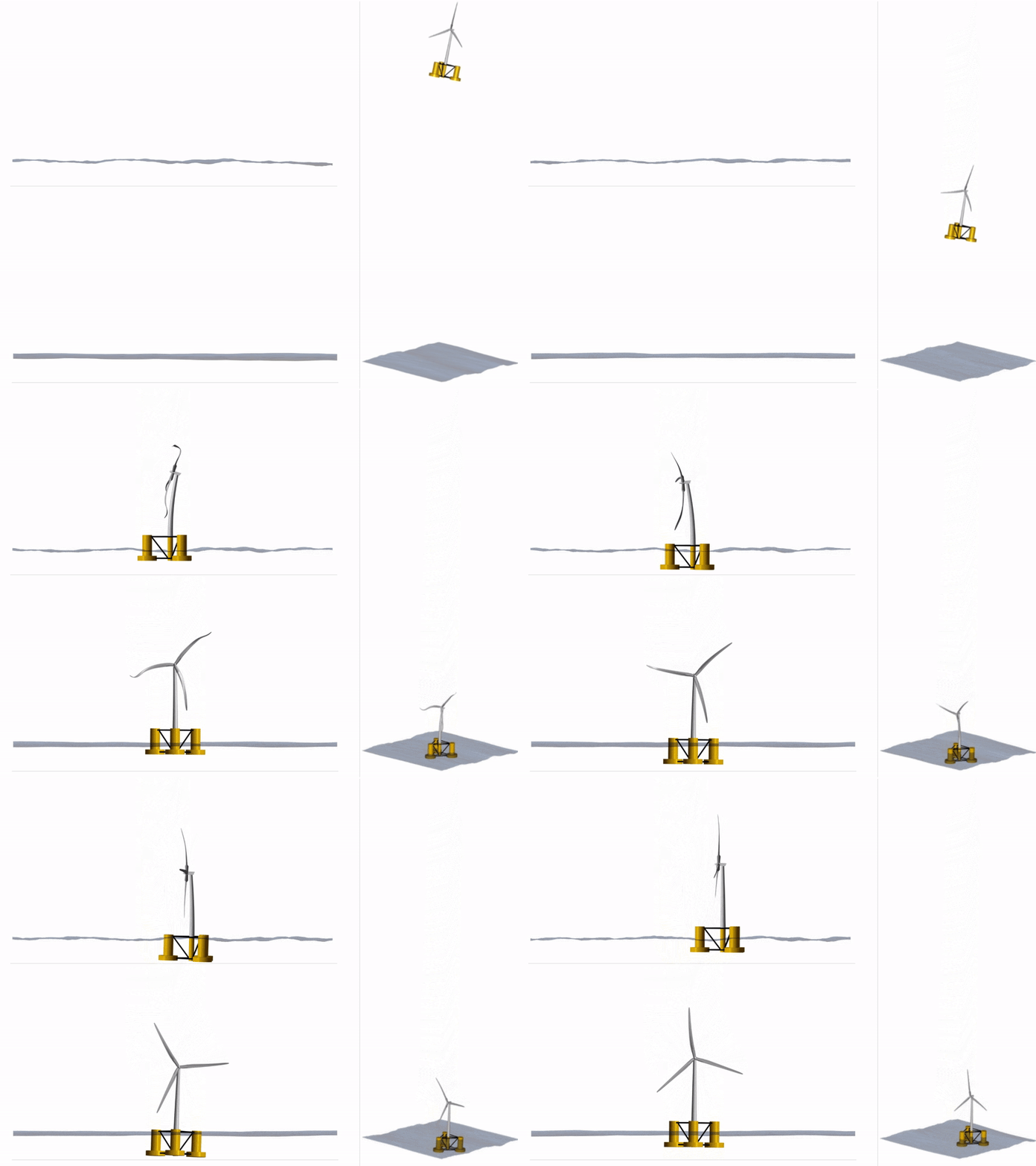
I am testing the behaviour of turbine when subject to wind towards downwind direction. In the attached model files, two identical turbines were created, one is configured as downwind turbine and the other is configured as upwind turbine. Upwind turbine is configured to rotate in reverse direction and the blade twist angles are negative of the downwind turbine blades. From the analysis replay, it appears that both turbines are operating in the exact same manner except some local axes are reversed.
While the measured wind velocities at the hub are negative of each other as expected, the turbine thrust load appears to be not consistent as they are not exact negative of each other. I’m curious if there is a fundamental effect which I have overlooked? Would it be possible to reliably use an upwind turbine model when it is subject to 180° wind heading?
Regards,
Andhi
Hi,
I would like to clarify if a downwind turbine subjected to wind in 0° direction would exhibit the same thrust load as an upwind turbine subjected to wind in 180° direction (with the appropriate reversal of rotor rotation and blade twist angles).
I am testing the behaviour of turbine when subject to wind towards downwind direction. In the attached model files, two identical turbines were created, one is configured as downwind turbine and the other is configured as upwind turbine. Upwind turbine is configured to rotate in reverse direction and the blade twist angles are negative of the downwind turbine blades. From the analysis replay, it appears that both turbines are operating in the exact same manner except some local axes are reversed.
While the measured wind velocities at the hub are negative of each other as expected, the turbine thrust load appears to be not consistent as they are not exact negative of each other. I’m curious if there is a fundamental effect which I have overlooked? Would it be possible to reliably use an upwind turbine model when it is subject to 180° wind heading?
Regards,
Andhi
Uploaded files:
- You need to login to have access to uploads.

Quote from David on 3. November 2025, 13:26Hi Andhi,
QBlade allows you to configure upwind/downwind and standard/reversed rotation directly in the turbine design module.
A downwind configuration simply means that the nacelle is extending in the downwind direction (instead of upwind) and does not affect the rotor rotation direction or blade geometry. So when looking from an upwind position an upwind or downwind rotor will always rotate in the same direction.
When choosing “reversed” rotation the blade geometry will automatically be “mirrored” accordingly – it is not required that the user regenerated a mirrored geometry manually.
I hope this answers your questions.
Best regards,
David
Hi Andhi,
QBlade allows you to configure upwind/downwind and standard/reversed rotation directly in the turbine design module.
A downwind configuration simply means that the nacelle is extending in the downwind direction (instead of upwind) and does not affect the rotor rotation direction or blade geometry. So when looking from an upwind position an upwind or downwind rotor will always rotate in the same direction.
When choosing “reversed” rotation the blade geometry will automatically be “mirrored” accordingly – it is not required that the user regenerated a mirrored geometry manually.
I hope this answers your questions.
Best regards,
David
Quote from Andhi.Kusnadi on 4. November 2025, 10:09Hi David,
I created the following 2 models as attached:
- Downwind turbine subject to 0° wind heading
- Upwind turbine subject to 180° wind heading
I would expect that the absolute magnitude of the turbine loads would be the same because the blades orientations and the direction of rotor rotation with respect to the wind direction is all the same. But that appears to be not the case as shown in the attached snapshot.
Best regards,
Andhi
Hi David,
I created the following 2 models as attached:
- Downwind turbine subject to 0° wind heading
- Upwind turbine subject to 180° wind heading
I would expect that the absolute magnitude of the turbine loads would be the same because the blades orientations and the direction of rotor rotation with respect to the wind direction is all the same. But that appears to be not the case as shown in the attached snapshot.
Best regards,
Andhi
Uploaded files:- You need to login to have access to uploads.
Quote from David on 4. November 2025, 14:26Hi Andhi,
the rotors for both upwind or downwind turbines are oriented in a way that the expected inflow is aligned with the positive X_g-direction.
The loads on these turbines (besides tower influence caused differenced) therefore should align for the same inflow direction. Setting the inflow to -180° means the wind is hitting the rotor from the back in both configurations. So you should rather compare upwind and downwind turbines for the same inflow direction.
BR,
David
Hi Andhi,
the rotors for both upwind or downwind turbines are oriented in a way that the expected inflow is aligned with the positive X_g-direction.
The loads on these turbines (besides tower influence caused differenced) therefore should align for the same inflow direction. Setting the inflow to -180° means the wind is hitting the rotor from the back in both configurations. So you should rather compare upwind and downwind turbines for the same inflow direction.
BR,
David
Quote from Andhi.Kusnadi on 5. November 2025, 08:48Hi David,
Just so we understand each other more clearly, should we expect the magnitude of turbine thrust loads to be the same for the two cases in the attached snapshot?
Regards,
Andhi
Hi David,
Just so we understand each other more clearly, should we expect the magnitude of turbine thrust loads to be the same for the two cases in the attached snapshot?
Regards,
Andhi
Uploaded files:- You need to login to have access to uploads.
Quote from David on 5. November 2025, 20:43Hi Andhi,
Just to clarify the point again:
When you set a turbine to downwind in QBlade, the only change is that the nacelle is extended downwind rather than upwind – nothing else changes. The rotor itself is simply translated to be positioned behind the tower.
When you change the rotation direction, the rotor geometry is automatically adjusted (e.g., mirrored in the x-z plane within the blade design module) to accommodate this change.
In your example, you should compare the upwind and downwind configurations using the same blade design and wind inflow from the same direction. This will ensure that your results are consistent.
Please dont manually adjust the blade to compensate for the reversed rotation direction.
That said, I understand what you’re trying to achieve by manually modifying the blade geometry. Here’s a suggestion to make that scenario work as expected:
a) Invert the airfoils in the blade you’ve created for the upwind turbine.
b) Use the LLFVW method for simulation. The UBEM doesnt handle inflow from the “back” direction perfectly well.Best regards,
David
Hi Andhi,
Just to clarify the point again:
When you set a turbine to downwind in QBlade, the only change is that the nacelle is extended downwind rather than upwind – nothing else changes. The rotor itself is simply translated to be positioned behind the tower.
When you change the rotation direction, the rotor geometry is automatically adjusted (e.g., mirrored in the x-z plane within the blade design module) to accommodate this change.
In your example, you should compare the upwind and downwind configurations using the same blade design and wind inflow from the same direction. This will ensure that your results are consistent.
Please dont manually adjust the blade to compensate for the reversed rotation direction.
That said, I understand what you’re trying to achieve by manually modifying the blade geometry. Here’s a suggestion to make that scenario work as expected:
a) Invert the airfoils in the blade you’ve created for the upwind turbine.
b) Use the LLFVW method for simulation. The UBEM doesnt handle inflow from the “back” direction perfectly well.
Best regards,
David